
Imagine getting permanent residency in Australia without an employer sponsoring you, without a state government nominating you, and without any regional living condition attached to your visa. That is exactly what the Australia skilled independent visa (subclass 189) offers. It is one of the most sought-after pathways under Australia’s General Skilled Migration program, and it is built purely on your own profile — your age, your education, your work experience, and your English ability — not on who you know or where you agree to live.
At Esse India, we talk to skilled professionals every week who feel confused about points, occupation lists, and processing times for this visa. This guide breaks everything down in plain, simple language, without heavy legal documents, so you know exactly where you stand and what your next step should be.
What Is the Australia Skilled Independent Visa (Subclass 189)?
The Australia skilled independent visa is a permanent visa granted under the points-tested stream of the General Skilled Migration program. Unlike many other work visas, it does not need an employer, a family member, or a state or territory government to support your application. You are invited purely on merit, based on your points score and your nominated occupation. For the 2025–26 program year
The Skill stream has around 132,200 places in total, shared across several skilled visa subclasses, and the subclass 189 is one of the most competitive precisely because it is fully independent. It sits alongside two close cousins — the Subclass 190 (Skilled Nominated) and the Subclass 491 (Skilled Work Regional) — but unlike them, the 189 visa never asks you to live in a particular state or region.
Why So Many Skilled Workers Choose This Visa
- Full permanent residency from the day your visa is granted
- Freedom to live, work, and study anywhere in Australia
- Access to Medicare, Australia’s public healthcare scheme
- A clear pathway to Australian citizenship after 4 years, including 12 months as a permanent resident
- The right to sponsor eligible family members for their own permanent residency later
- No employer, no state government, and no regional living condition attached
Eligibility Criteria for the Australia Skilled Independent Visa
Before you get excited about the benefits, check whether you actually meet the basic entry conditions:
- Be under 45 years of age at the time you are invited to apply
- Nominate an occupation listed on the Medium and Long-term Strategic Skills List (MLTSSL)
- Hold a positive skills assessment from the relevant assessing authority for that occupation
- Achieve at least Competent English
- Score a minimum of 65 points on the points test (in practice, invitations usually go to much higher scorers)
- Meet standard health and character requirements
- Have no outstanding debts to the Australian government
- New Zealand citizens have a separate stream with slightly different conditions
Which Occupations Qualify?
Not every occupation qualifies. Your job must appear on the Medium and Long-term Strategic Skills List (MLTSSL), and a few sectors regularly see strong invitation activity:
- Registered Nurses and other healthcare professionals
- Software Engineers, Developers, and ICT specialists
- Civil, Mechanical, and Electrical Engineers
- Electricians and other skilled trades
- Early Childhood and Secondary School Teachers
- Accountants and Auditors
This list changes periodically, so always check the current MLTSSL on the Department of Home Affairs website before you invest time and money in a skills assessment.
How the Points Test Works
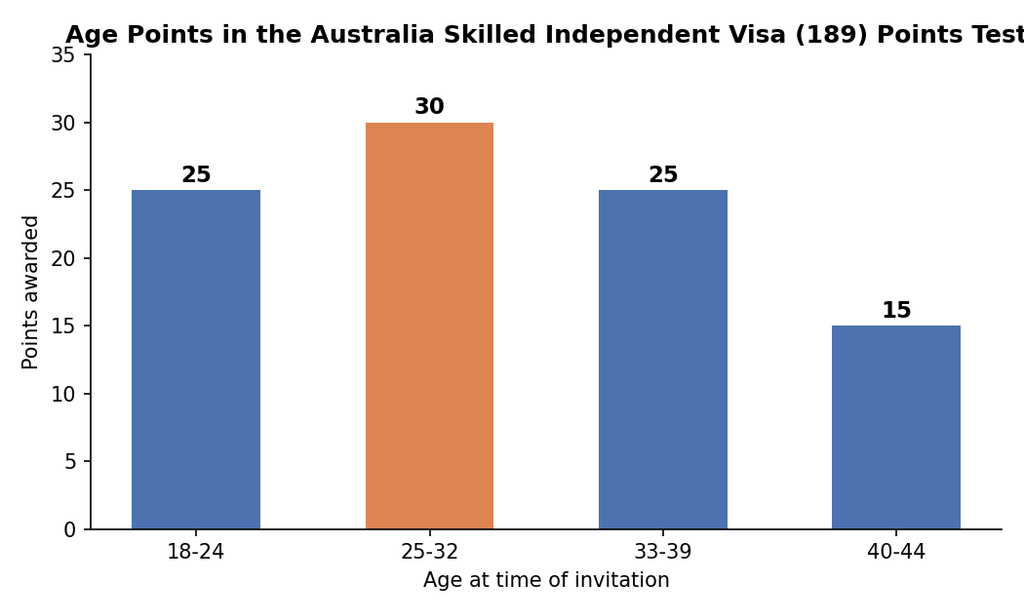
Points are what actually decide whether you receive an invitation, since the 65-point minimum is only a starting line, not a guarantee. Here is how the main categories break down:
| Category | Points available |
| Age | up to 30 |
| English language ability | up to 20 |
| Skilled employment — overseas | up to 15 |
| Skilled employment — in Australia | up to 20 |
| Educational qualification | up to 20 |
| Specialist STEM qualification | 10 |
| Australian study requirement | 5 |
| Professional Year in Australia | 5 |
| Credentialed community language | 5 |
| Study in regional Australia | 5 |
| Partner skills | 10 |
For Example
Meet Ananya, a 28-year-old software engineer in Pune. She has 4 years of overseas work experience in her nominated occupation, a Bachelor’s degree in Computer Science, and an 8 in every band of IELTS. Here’s how her points add up:
- Age (25–32): 30 points
- Superior English (IELTS 8 each band): 20 points
- Overseas experience of 3–5 years: 5 points
- Bachelor’s degree: 15 points
- Single applicant: 10 points
Total: 80 points — a strong, competitive score for the Australia skilled independent visa, well above the 65-point minimum.
English Language Requirements
| Level | IELTS (each band) | PTE Academic (each) | Points |
| Competent | 6.0 | 50 | 0 |
| Proficient | 7.0 | 65 | 10 |
| Superior | 8.0 | 79 | 20 |
Step-by-Step: How to Apply
- Check your occupation against the MLTSSL
- Get a positive skills assessment from the relevant authority
- Take an approved English test
- Submit your Expression of Interest (EOI) through SkillSelect
- Wait for an invitation to apply (ITA)
- Lodge your visa application within 60 days and pay the visa application charge
- Complete medical exams and submit police clearance certificates
- Wait for a decision from the Department of Home Affairs
Visa Fees & Costs
| Applicant | Approximate fee (AUD, 2026) |
| Primary applicant | around $6,135 |
| Partner or spouse (18+) | around $3,070 |
| Child (under 18) | around $1,535 |
How Long Does It Take?
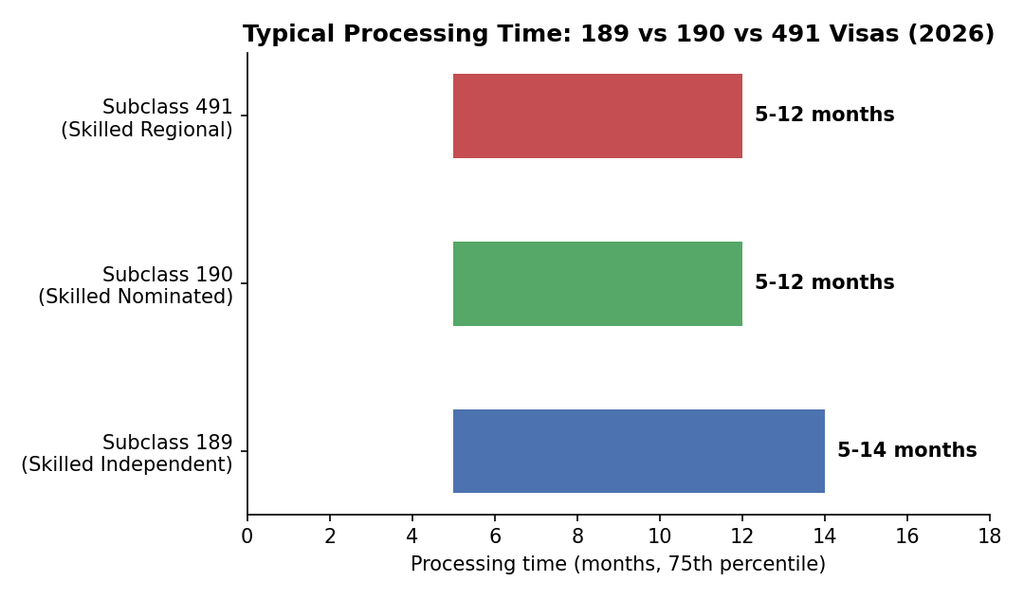
Processing time for the Australia skilled independent visa currently sits between 5 and 14 months at the Department’s 75th percentile, though a strong points score, a complete document set, and a straightforward occupation can bring this closer to the lower end.
Who Can You Include in Your Application?
- Spouse or partner
- Dependent children or stepchildren who are unmarried and under 23 (or older if they cannot support themselves due to a disability)
Health and Character Requirements
- Medical examinations, valid for 12 months from the date of the exam
- Police clearance certificates from every country you lived in for 12 months or more since turning 16, within the last 10 years
Common Mistakes That Slow Down or Reject 189 Applications
- Claiming work experience that isn’t in the same or a closely related occupation to your nomination
- Missing the 60-day deadline to lodge your visa after receiving your invitation
- Using an expired skills assessment
- Weak reference letters that don’t clearly state duties, hours, and dates
- Quitting your current job too early, before your visa is actually granted
- Forgetting to update your EOI after a better English or points-test result
Subclass 189 vs 190 vs 491: Which Should You Choose?
| Feature | Subclass 189 | Subclass 190 | Subclass 491 |
| Sponsorship needed | None | State nomination | State or family sponsorship |
| Bonus points | 0 | +5 | +15 |
| Living condition | None | None (some states ask for a stay commitment) | Must live & work in a regional area |
| Visa type | Permanent | Permanent | Provisional (pathway to permanent Subclass 191 after 3 years) |
| Competition level | Highest | Moderate | Lowest |
Conclusion
The Australia skilled independent visa remains one of the cleanest, most independent routes to Australian permanent residency available today — no employer, no state, and no regional strings attached. The trade-off is competition: you need a strong points score and a clean, well-documented application. Take the time to calculate your points honestly, get your skills assessment sorted early, and keep your documents ready before you submit your EOI. And if you’d like a second opinion on your profile, Esse India is here to help you plan your next step with confidence.
Frequently Asked Questions
What is the minimum points score for the Australia skilled independent visa?
65 points is the technical minimum, but recent invitation rounds have mostly gone to applicants scoring 75 to 90+ points.
Do I need a job offer to apply for this visa?
No. It is entirely independent of any employer — your points score and nominated occupation are what matter.
How long does the Australia skilled independent visa take in 2026?
Typically between 5 and 14 months from invitation to grant, based on current Department of Home Affairs data.
Can I bring my spouse and children with me?
Yes, your spouse or de facto partner and dependent children can be included as additional applicants.
How often are invitations issued?
Invitations are generally issued in rounds through the program year, with the Department publishing indicative dates in advance so applicants can track when their occupation might be called.
Is the visa fee refundable if my application is refused?
No, the visa application charge is not refundable, even if the refusal is due to missing documents.
How is the 189 visa different from the 190 visa?
The 190 visa requires state nomination and adds 5 points, but may come with a request to live in that state for a period. The 189 has no such conditions.
Can I update my English test score after submitting my EOI?
Yes, you can update your EOI at any time before receiving an invitation, including with a new English score.
If I score exactly 65 points, will I be invited?
It’s possible but unlikely in most occupations, since invitation rounds are competitive and usually favour higher scorers.
Can I apply for Australian citizenship after getting this visa?
Yes, after holding permanent residency and meeting the general residence requirement, which includes at least 12 months as a permanent resident within a 4-year period in Australia.